


Fix & Flip Profit & Cost Calculator — Maximize Your House‑Flipping ROI with Hard Money Loans
Our Fix & Flip Profit & Cost Calculator gives investors a clear snapshot of potential returns before they buy a property. It estimates the key costs and projected profit tied to purchasing, renovating, holding, and selling a house so you can make smarter, faster decisions. Many flippers lose money by underestimating costs or misreading market signals — this guide walks you through how the calculator works, the main cost drivers, the 70% rule, how hard money fits into the plan, and real examples that show what a successful flip looks like.
How this Fix & Flip Profit & Cost Calculator Works
The calculator collects property and project details, then runs those figures against standard cost assumptions to produce an estimated profit and ROI. It’s built to give you a realistic financial picture so you can make data‑driven choices at every stage of a flip.
What inputs produce reliable profit estimates?
To get accurate results, the calculator needs a handful of core inputs:
- Purchase Price: What you pay to acquire the property.
- Renovation Costs: Your best estimate for repairs and improvements.
- Holding Costs: Expenses while you own the property during rehab — mortgage, utilities, insurance, and taxes.
- Selling Price: The price you expect to achieve when the property sells.
- Selling Costs: Costs tied to the sale, such as agent commissions and closing fees.
Each input moves the profit needle — use realistic figures and keep backup estimates for contingencies.
How the calculator derives Net Profit and ROI
Net profit is calculated by subtracting your total project costs from the expected sale price. The formulas used are:
And return on investment (ROI) shows project efficiency:
These calculations help you compare deals and prioritize the projects with the best risk‑adjusted returns.
Key cost components in fix & flip projects
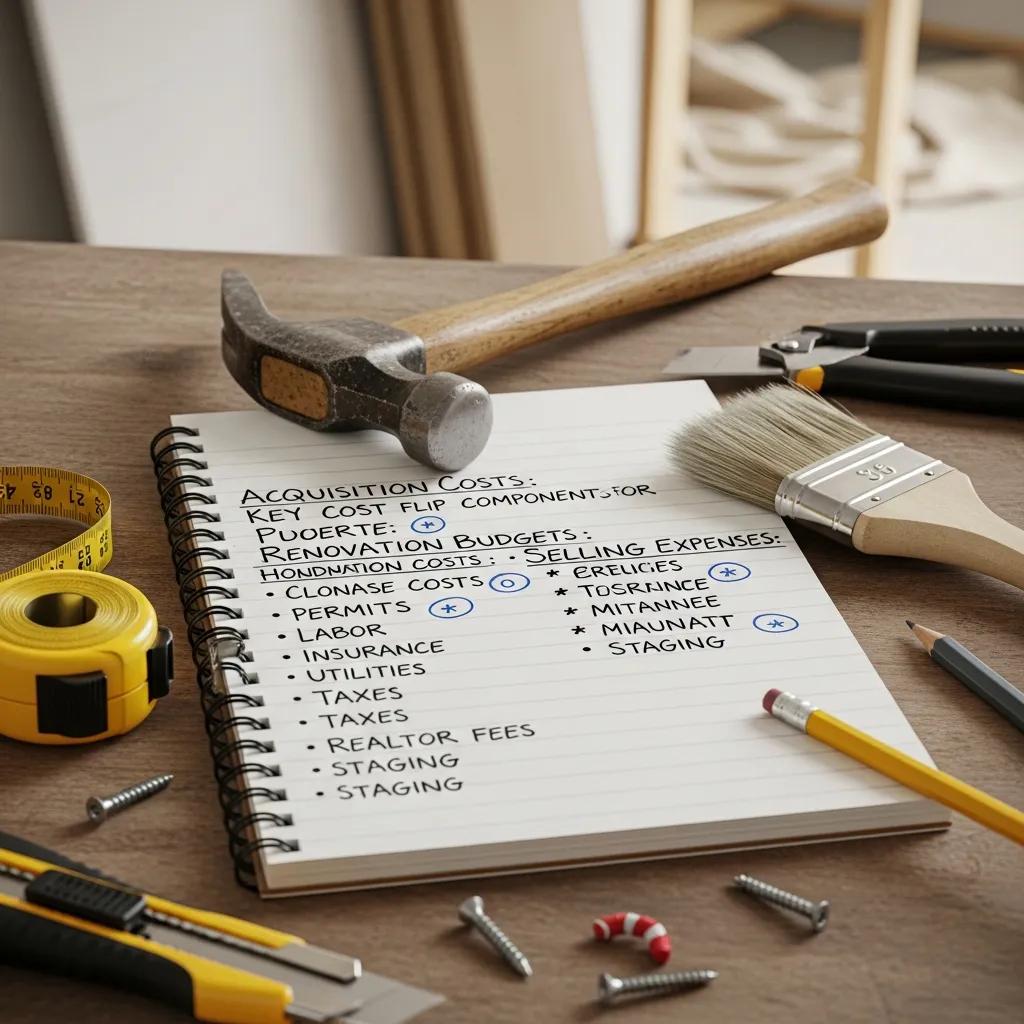
Accurate budgets depend on understanding the four primary cost buckets: acquisition, renovation, holding, and selling. Overlooking even one can erode your profit margin.
How to calculate acquisition, renovation, and holding costs
Break these costs down like this:
- Acquisition Costs: The purchase price plus any closing fees tied to the acquisition.
- Renovation Costs: A realistic total for labor, materials, permits, and contractor markups based on the scope of work.
- Holding Costs: Ongoing line items during the rehab — loan payments, property taxes, insurance, and utilities.
Document assumptions and build in a contingency buffer so small surprises don’t become project‑ending problems.
Which selling costs should you include?
When forecasting the sale, account for:
- Realtor Fees: Commonly 5–6% of the final sale price.
- Closing Costs: Title, transfer fees, and other transaction expenses.
- Final Touches or Staging: Any last repairs or staging needed to secure the sale.
These expenses reduce your net proceeds, so factor them into your minimum acceptable profit target.
How the 70% rule guides fix & flip decisions
The 70% rule is a quick screening tool investors use to estimate the maximum purchase price that preserves profit after repairs.
What the 70% rule is and how to apply it
The guideline says pay no more than 70% of the After Repair Value (ARV), minus repair costs. In formula form:
It’s a starting point to avoid overpaying and to leave room for holding and selling expenses.
When the 70% rule falls short
Though useful, the rule doesn’t replace detailed analysis. It won’t capture unique market dynamics, local demand shifts, or specific property quirks. In hot markets buyers may stretch beyond 70%, and some holding or selling costs are overlooked. Always layer market research and a full budget over this quick test.
How hard money loans support fix & flip projects

Hard money loans are a common solution for flippers who need speed and flexibility. Secured by the property, they typically have a faster approval path than conventional financing.
Hard money fix & flip loans from Fidelity Funding
Fidelity Funding offers hard money solutions crafted for flips. These products help you close quickly and start renovations without long bank delays. Typical benefits include:
- Fast approvals: Funding often within 24–48 hours.
- Flexible terms: Options structured around your project timeline and exit strategy.
- Equity‑focused underwriting: Decisions weigh the property’s value and rehab plan more than personal credit.
How loan terms influence project profitability
Loan details — interest rate, term length, origination fees — directly affect your carrying costs and net profit. Higher rates and fees lower returns, while longer terms can increase holding costs. Evaluate offers against your budget and timeline to ensure financing supports your target ROI.
Real‑world examples of successful fix & flip projects
Reviewing real flips shows how planning, capital, and execution come together to produce profits — and where projects can go wrong.
How Fidelity Funding’s loans helped investors close profitable flips
We’ve helped investors secure fast capital to buy distressed properties, complete renovations, and resale for a profit within months. Quick funding lets buyers act on good deals and avoid losing ground in competitive markets.
What case studies teach us
Across successful projects, a few consistent behaviors stand out:
- Accurate budgeting: Top flippers account for every line item and a contingency for surprises.
- Market research: Knowing neighborhood comps and buyer expectations sets realistic pricing.
- Quality renovations: Thoughtful upgrades that match the market attract buyers faster and at higher prices.
These practices minimize risk and improve the odds of a strong return.
Common questions about fix & flip profit calculations
Below are answers to frequent investor questions about valuing deals and managing flip projects.
How do you calculate After Repair Value?
ARV is the expected market value after renovations. To estimate ARV:
- Compare recent sales of similar homes in the neighborhood.
- Adjust for upgrades that change market value (finished basement, new kitchen, etc.).
- Get a professional opinion from an agent or appraiser for added accuracy.
What’s a healthy profit margin for flipping?
Many investors target 10%–20% net profit on total investment as a reasonable goal. Actual margins vary by market and deal structure; always stress‑test your assumptions.
Use the breakdown below to see how typical costs stack up and what portion of your budget they represent.
The table shows typical cost distribution so you can spot where savings or overruns will most affect your profit.
Frequently Asked Questions
What risks should I expect with fix & flip investments?
Flips carry market risk, surprise repair costs, and timing risk if a property takes longer to sell. A downturn can shrink resale value and push up holding costs. Mitigate risk with conservative budgets, contingency funds, and solid market analysis.
How do I find promising flip properties?
Look for distressed or underpriced homes in neighborhoods with stable demand. Use MLS searches, auctions, local wholesalers, and agent relationships. Networking with other investors often uncovers off‑market opportunities.
What financing alternatives exist besides hard money?
Options include conventional bank loans (slower, stricter requirements), HELOCs (if you have equity elsewhere), private lenders, and crowdfunding platforms. Each has tradeoffs in speed, cost, and underwriting standards.
Why is market research so important?
Market research tells you what buyers want and what similar homes sell for. It guides renovation decisions and pricing so you don’t overbuild or misprice the property.
What common mistakes should I avoid when flipping a house?
Avoid underestimating rehab costs, skipping market analysis, overpaying, and cutting corners on quality. Also plan for holding costs and schedule delays; those are frequent profit killers.
How can I keep renovation timelines on track?
Create a detailed schedule with milestones, confirm contractor availability, secure permits early, and maintain regular check‑ins. Build in extra time for inspections and delivery delays so the project stays on budget.
Conclusion
The Fix & Flip Profit & Cost Calculator helps investors evaluate deals with clarity and confidence. By estimating true costs and potential returns — and pairing the right financing, like hard money, when appropriate — you can improve decision‑making and protect your profits. Ready to sharpen your deal analysis? Explore our tools and resources to start optimizing your next flip.