


Real Estate ROI Calculator — Maximize Property Returns with Precision
Real estate can be a highly profitable investment, but the outcome depends on accurate numbers. This guide introduces the Real Estate Investment ROI Calculator — a practical tool that helps investors estimate returns, compare scenarios, and make decisions that protect profit. Many investors misjudge ROI and end up with underperforming deals; our calculator uses the right inputs to remove guesswork. Below we cover what ROI means, the key metrics to track, how the Fidelity Funding ROI Calculator works, the effect of hard money financing, and market trends to watch for 2025.
What is real estate ROI and why it matters for investors
Return on Investment (ROI) shows how much profit an investment generates relative to what you put in. Expressed as a percentage, it helps you compare deals and judge whether an opportunity meets your targets. A reliable ROI calculation clarifies which projects earn your time and capital—and which ones don’t.
How ROI is defined in real estate
In real estate, ROI equals the net profit divided by the total investment, shown as a percentage. The basic formula is:
Example: buy a property for $200,000, sell for $250,000 after expenses — net profit is $50,000. So:
That 25% figure helps you measure the deal’s success and compare it to alternatives.
Why precise ROI calculations change investment outcomes
Accurate ROI prevents costly mistakes. Overestimating returns can push you into a weak deal; underestimating them can keep you from opportunities that are actually profitable. Investors who use precise metrics make clearer decisions, plan better exits, and are more likely to hit financial goals.
Which key metrics sharpen real estate analysis?
Beyond ROI, several metrics give a fuller picture of a property’s financial performance. Important measures include ROI, capitalization rate (cap rate), and cash-on-cash return. Each one highlights a different dimension of value and risk.
How to calculate ROI, cap rate, and cash‑on‑cash return
The core formulas are:
- ROI: As shown above,
ROI = (Net Profit / Total Investment Cost) × 100 - Cap Rate: Compares income to property value:
Cap Rate = (NOI / Property Value) × 100 - Cash-on-Cash Return: Looks at cash income versus cash invested:
Cash-on-Cash Return = (Annual Cash Flow / Total Cash Invested) × 100
How cash flow and IRR factor into decisions
Cash flow tracks actual dollars moving in and out of a property and is essential for covering expenses and servicing debt. Internal Rate of Return (IRR) evaluates returns over time by finding the discount rate that makes the net present value of cash flows zero. Together they help you evaluate both short‑term liquidity and long‑term profitability.
How the Fidelity Funding ROI Calculator helps investors
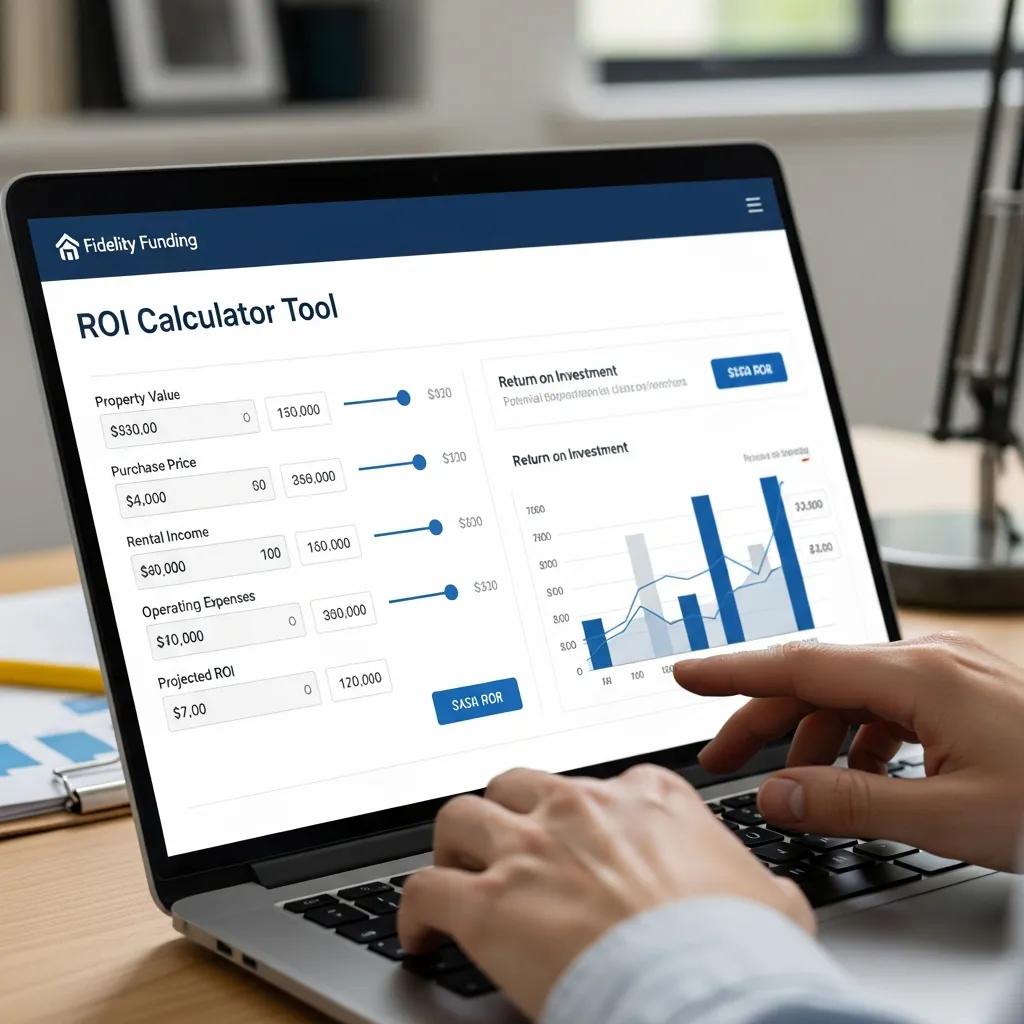
Our ROI Calculator is built to give clear, actionable results from the inputs you provide. It’s designed for investors who need reliable estimates fast so they can compare scenarios and make confident choices.
Which inputs produce an accurate ROI estimate?
To get useful results, enter the main variables the calculator asks for, including:
- Purchase Price: The total acquisition cost of the property.
- Selling Price: The anticipated sale price when you exit.
- Operating Expenses: Recurring costs like taxes, insurance, maintenance, and management.
- Financing Costs: Interest, origination fees, and other loan-related expenses.
Providing realistic figures for each item gives you a much clearer picture of potential returns.
What outputs — ROI, cash flow, cap rate — look like
The calculator returns straightforward metrics so you can act on them. Typical outputs include:
- ROI Percentage: The deal’s overall profitability expressed as a percent.
- Cash Flow Analysis: A breakdown of cash inflows and outflows so you can see monthly or annual liquidity.
- Cap Rate Calculation: A quick assessment of income relative to property value.
These results let you compare investments side‑by‑side and stress‑test financing options.
How hard money loans affect real estate ROI
Hard money financing can change the math on a deal. These loans are typically secured by the property and are favored for short-term projects where speed and flexibility matter more than low rates.
How fast funding supports time‑sensitive opportunities
A major advantage of hard money is speed: funding can close in roughly 3 to 7 days, letting you move on competitive listings or time‑sensitive flips. That speed can preserve a deal’s value when delays would otherwise cost you the opportunity.
Benefits of higher LTVs and no prepayment penalties

Hard money lenders often offer moderate to high loan‑to‑value (LTV) ratios—commonly 60% to 75%—which lets you leverage more capital. Many lenders also avoid prepayment penalties, so you can repay early without extra fees. Those features can boost effective ROI by reducing upfront cash needs and preserving upside when exits happen sooner than planned.
Which investment types benefit most from ROI calculations and financing?
ROI modeling and the right financing apply across strategies, but the inputs and priorities differ by asset type. Knowing those differences helps you choose projects and funding that fit your goals.
Using ROI calculators for fix‑and‑flip projects
Fix‑and‑flips rely on precise budgeting. Plug purchase price, rehab costs, holding costs, and expected sale price into the calculator to see whether projected profit meets your hurdle rate and to budget contingencies.
ROI considerations for rental and commercial properties
Rental properties require factoring in recurring costs—management fees, maintenance, vacancy and turnover—while commercial assets often add lease structures, tenant credit risk, and longer vacancy cycles. Accurate ROI and cash‑flow projections are essential to underwrite these differences.
What 2025 market trends will affect investment ROI?
Looking to 2025, a few shifts deserve attention. Monitoring them helps you adapt underwriting and financing choices.
How appreciation and inventory levels influence ROI
Appreciation raises exit values and can materially increase ROI, while inventory tightness affects pricing and competition. Track local appreciation trends and supply levels to choose better entry and exit windows.
Emerging trends to consider for strategic financing
Changes like wider remote‑work adoption and shifting demographics are reshaping demand across geographies and property types. Align financing and hold strategies to where demand and rental fundamentals are strengthening.
This table highlights the core metrics investors should monitor. Together they give a balanced view of profitability, value, and liquidity.
Real estate investing requires disciplined analysis and clear planning. Using the Fidelity Funding ROI Calculator helps you quantify outcomes, compare scenarios, and choose strategies that improve your chances of success. Keep watching financing terms and market signals, and use reliable numbers to guide every buy, hold, and sell decision.
Frequently Asked Questions
What’s the difference between ROI and cash‑on‑cash return?
ROI measures overall profitability against total invested capital, including appreciation and all costs. Cash‑on‑cash return focuses only on the actual cash earned versus the cash you put in, making it useful for judging short‑term cash yield from rental operations or leveraged deals.
How can I improve my ROI on a real estate investment?
Improve ROI by increasing value (targeted renovations, rent optimization), cutting avoidable expenses (efficient management, lower financing costs), and choosing strong markets. Smart use of leverage—where terms support your exit plan—can also enhance returns.
What risks come with using hard money loans?
Hard money is fast and flexible but usually carries higher interest and shorter terms. That can squeeze cash flow and force a quick exit if the project stalls. Always have a clear exit strategy and contingency budget before using short‑term financing.
How do I choose the best financing for my project?
Match financing to your strategy: short, fast projects often suit hard money; long‑term holds usually benefit from traditional mortgages or commercial loans with lower rates. Compare costs, term length, flexibility, and exit options before deciding.
Why is market research important for maximizing ROI?
Market research reveals demand drivers, price trends, and local risks—insights that affect purchase decisions, rent assumptions, and exit timing. Data-driven underwriting reduces surprises and improves long‑term returns.
Can I use the ROI Calculator for commercial investments?
Yes. The same core calculations apply; just tailor inputs to commercial specifics—projected NOI, lease terms, tenant improvements, and longer vacancy assumptions—to get accurate results.
Conclusion
The Fidelity Funding ROI Calculator gives investors clear, actionable estimates so you can plan and execute with confidence. By understanding key metrics, the effects of financing, and evolving market trends, you’ll make smarter choices that protect and maximize returns. Explore the calculator and our resources to start evaluating deals more effectively today.