

Fast Funding with Hard Money Lending for Real Estate Investors
Hard money loans are short-term, asset-backed loans that prioritize property equity and speed over traditional credit-based underwriting, giving investors quick access to capital for time-sensitive deals. This article shows how hard money accelerates acquisitions and rehabs, explains common program types and terms, and walks through the step-by-step process from application to funded closing. When conventional lenders can’t move fast enough, private lending fills the gap by underwriting to property value and exit strategies rather than relying solely on income documentation. You’ll get clear guidance on the core benefits, typical approval and funding timelines, program choices aligned with common investor strategies, and how terms like LTV, rates, and fees influence returns. Each section includes practical checklists, comparison tables, and real-world examples so you can evaluate leverage, timing, and documentation needs for California markets and similar regions.
What Are the Key Benefits of Hard Money Loans for Real Estate Investors?
Hard money lending gives investors practical advantages when speed and flexibility matter. The main benefits are fast approvals and closings, underwriting centered on property equity and ARV instead of credit alone, and loan structures that can be tailored to purchase, rehab, or bridge needs. Those features let investors act quickly at auctions, meet short escrows, and preserve deals that traditional lenders would miss—reducing opportunity cost and getting projects underway sooner. Knowing these advantages helps you choose financing that minimizes time-to-close while preserving leverage and exit flexibility.
Operationally, hard money differs from banks because decisions are made in-house, due diligence focuses on collateral value, and documentation is streamlined. Those differences translate to measurable time savings for approval and funding. The next section explains why that speed is possible and compares typical bank timelines with private-lender workflows.
Hard money advantages at a glance:
- Speed of Funding: Underwriting and closings are structured to finish in days rather than weeks.
- Equity-Focused Underwriting: Lenders evaluate property value and ARV as the primary collateral.
- Flexible Terms: Programs can include rehab draws, bridge features, and short terms aligned to exits.
Combined, these strengths help investors secure deals that would otherwise lapse under traditional financing. The section that follows breaks down the operational steps that enable fast execution.
For example, Fidelity Funding regularly demonstrates these benefits by issuing approvals within 48 hours and funding typical fast-close transactions in 5–7 days. As a direct private lender with in-house underwriting, the firm offers multiple LTV programs, selective no-prepayment-penalty options, and a broad range of loan sizes to support diverse investor needs in California. That practical model shows how speed and program flexibility preserve real-world deals.
How Does the Hard Money Loan Approval Process Work for Quick Funding?
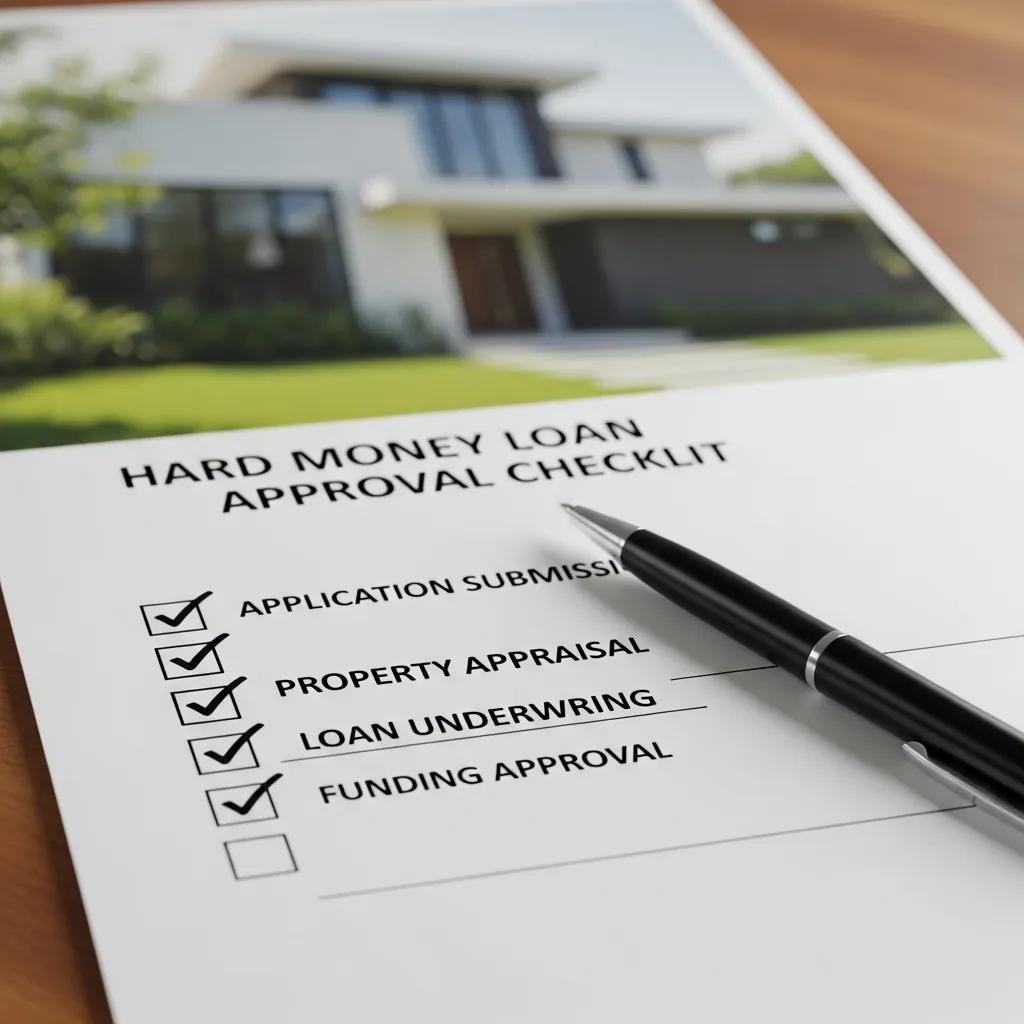
A fast hard money approval follows a short, repeatable sequence: initial property review, focused underwriting and valuation, conditional approval, then coordinated closing and funding. Because collateral value and a clear exit drive decisions, the process minimizes borrower paperwork and concentrates on title status, property condition, and the exit plan. Tight communication and having core documents ready in advance compress timelines and cut down the conditional items that usually slow closings.
To make timelines and requirements easy to follow, the table below summarizes each approval step, typical duration, and the documents or outcomes lenders expect so you can plan around a rapid close.
The core approval timeline and checklist
| Approval Step | Typical Duration | Required Documents / Outcome |
|---|---|---|
| Initial inquiry & property review | 24–48 hours | Basic property details, purchase contract or property address, proof of available equity |
| Underwriting & valuation | 48–72 hours | Appraisal or valuation, title search initiation, scope of work for rehab if applicable |
| Approval & clear-to-close | 24–48 hours after underwriting | Conditional approval letter, closing instructions, lender conditions list |
| Closing & funding | 1–5 days after clear-to-close | Final title, signed loan docs, funding wire or escrow instructions |
This concise table sets expectations so investors can align title, appraisal, and contractor readiness. Assembling the listed documents and responding quickly to underwriting questions are the best ways to meet fast-funding targets.
Practical steps to preserve speed include ordering available property reports ahead of time, selecting title and escrow partners who prioritize short windows, and having contractor estimates or a written exit plan ready. The next section outlines timeline variables that affect how quickly funding completes.
What Are the Typical Timelines for Approval and Funding With Fidelity Funding?
With a direct private lender, streamlined decision-making and focused documentation review allow approvals and closings much faster than conventional routes. For many straightforward purchase or rehab deals, approval can occur within 48 hours of a full submission, and funding commonly follows in 5–7 days once title and closing conditions are satisfied. These timelines assume clear title, timely borrower responses, and available valuation work; unresolved liens, complex commercial appraisals, or contractor delays can extend the schedule.
To keep a deal on the fast track, provide a complete purchase contract, evidence of equity or down payment, and contractor bids for rehab projects at the time you apply. Early communication about your exit—refinance, resale, or rental—also reduces conditional items and speeds closing. The following section lists the core documents lenders expect for rapid approval.
Which Documents and Requirements Are Needed for Fast Hard Money Loan Approval?
Fast approvals depend on a compact, targeted document package that emphasizes property and project facts over exhaustive personal income documentation. Typical items include the purchase agreement or current deed, recent rent rolls or P&L statements for income-based loans, contractor bids and scopes of work for rehab financing, and bank statements or proof of funds showing the borrower can close. Title reports and clear lien searches are essential to confirm acceptable collateral.
You can accelerate underwriting by assembling these documents before submission and by answering valuation and title questions promptly. Lenders commonly accept alternative income verification—such as P&L statements or DSCR calculations—when tax returns aren’t available, which supports rapid underwriting for investors with nonstandard documentation. The next section maps primary program types and what each requires.
What Types of Hard Money Loans Does Fidelity Funding Offer for Different Investment Needs?
Hard money lenders offer a range of programs to fit investor strategies: purchase loans, fix-and-flip financing, foreclosure bailouts, bridge and construction loans, second-trust-deed financing, DSCR loans for rentals, and P&L-based approvals for borrowers without conventional income docs. Each product serves a specific use case—flips need rehab draw schedules, DSCR loans focus on rental cash flow, and P&L approvals let self-employed borrowers qualify. The key is selecting the product whose structure, LTV, and term match your exit plan.
To make comparison easy, the table below maps loan types to common uses, typical terms, LTV ranges, and the documents that speed approval.
Program comparison by purpose and typical attributes
| Loan Type | Best For / Typical Term / LTV Range | Example Scenario |
|---|---|---|
| Purchase Loan | Quick acquisition financing; short-term (6–24 months); LTV commonly 60–75% | Investor buying a distressed rental at a short escrow to renovate and refinance |
| Fix and Flip Financing | Acquisition + rehab draws; term 6–12 months; LTV to ARV up to 70–75% | Flipper buys, renovates using draw schedule, sells for ARV exit |
| Foreclosure Bailout / Seconds | Rescue finance or second-lien solutions; short terms; LTV depends on senior liens | Property facing imminent sale gets cash infusion to clear default or reposition |
| DSCR / P&L Based Loans | Rental cash-flow underwriting or business income approvals; medium term; LTV varies | Small portfolio owner seeking refinance based on property DSCR or business P&L |
This snapshot helps you match program features to your exit plan and shows which documents and terms most affect approval speed and leverage. The next sections dive deeper into fix-and-flip mechanics and income-based DSCR/P&L loans so you can assess fit and prepare the right materials.
How Do Fix and Flip Loans Support Short-Term Real Estate Projects?
Fix-and-flip loans bundle acquisition financing with a rehab budget that’s disbursed via a controlled draw schedule tied to contractor milestones and lender inspections. Lenders fund the purchase and then release rehab draws as work completes, which reduces initial cash outlay and aligns capital with project progress. Underwriting focuses on ARV, a realistic rehab budget, and a clear exit plan—sale or refinance—so terms support a predictable turnaround and sale timeline.
To improve approval odds, present a clear scope of work, contractor bids, and a conservative ARV. Regular inspections protect the lender’s collateral and help prevent over-capitalization, while a defined exit timeline limits carrying costs. The next section contrasts DSCR and P&L underwriting for rental- or business-backed deals.
What Are DSCR and P and L Based Loans, and Who Benefits From Them?
DSCR loans underwrite to property cash flow, using the debt-service-coverage ratio to show whether rental income covers debt obligations. P&L-based approvals evaluate business income when borrowers lack traditional wage documentation. A DSCR calculation divides net operating income by annual debt service to demonstrate an asset’s capacity to carry debt; P&L underwriting reviews company revenue and expenses to verify sustainable cash flow. Both approaches suit investors whose income profiles don’t fit standard tax-return underwriting.
Borrowers who want to qualify on property performance—rather than personal credit—use DSCR loans to scale rental portfolios, while entrepreneurs and self-employed operators rely on P&L approvals when W-2s or tax returns aren’t representative. Clear rent rolls, operating statements, and accurate P&L documents are critical to support these loan types and speed approval. The next section explains how loan terms change investor economics.
How Do Loan Terms Like LTV, Interest Rates, and Fees Affect Hard Money Loan Benefits?
LTV, interest rate, and fees determine your effective cost of capital and how much leverage you can access—directly shaping project ROI and downside risk. Higher LTV boosts purchasing power but usually requires stronger property fundamentals or borrower experience. Higher rates increase carrying costs and shrink margins on short-term exits. Origination fees, due-diligence costs, and closing expenses also reduce net proceeds and should be included in your project budget.
Compare program numbers against your exit plan and timeline: a short, high-rate flip can still be profitable if the hold is brief and ARV is secure, while rental strategies need careful DSCR analysis and lower effective rates. The table below gives representative LTV, term, rate guidance, and investor impact to help with selection.
Loan program terms and investor impact
| Loan Program | LTV / Term / Typical Rate / Fees | Investor Impact / Use Case |
|---|---|---|
| Fix & Flip | LTV to ARV 65–75% / 6–12 months / higher short-term rate / origination fee | Enables acquisition and rehab; higher carrying cost offset by quick sale |
| Purchase Loan | LTV 60–75% / 6–24 months / moderate rate / standard fees | Facilitates quick purchases; useful for competitive offers with short exits |
| DSCR Loan | LTV 60–75% / 12–36 months / rate tied to cash-flow metrics / fees apply | Best for rental holds where cash flow supports debt service and longer terms |
| Foreclosure Bailout | LTV varies / very short term / premium rates / expedited fees | Preserves distressed deals where timing outweighs cost concerns |
That comparison highlights how LTV and fees change the math for each strategy, so choose the program whose leverage and cost fit your exit horizon. The following subsections quantify typical LTV ranges and fee expectations so you can estimate capital needs precisely.
What Loan-to-Value Ratios Does Fidelity Funding Offer on Hard Money Loans?
LTV is the principal risk control lenders use. Typical hard money ranges are mid-60s to mid-70s, with select strong deals qualifying up to 80% under the right conditions. Higher LTV approvals depend on solid ARV support, clear title, an experienced borrower track record, and attractive property type or location. Model borrower equity by subtracting lender LTV from purchase price or ARV to calculate cash-to-close for acquisition and rehab.
Stretching LTV increases leverage but reduces the margin for error, so keep contingency reserves and conservative assumptions. Detailed ARV support and evidence of prior successful exits or portfolio strength improve the chance of higher-LTV offers. The next subsection covers prepayment policies and fees that affect short-term strategies.
Are There Prepayment Penalties or Other Fees Borrowers Should Know About?
Budget for origination fees, appraisal and due-diligence costs, title and escrow fees, and potential inspection charges—these reduce the net capital available for the project. Some lenders also include exit fees or yield-maintenance in select programs, but competitive private lenders may offer no prepayment penalties or flexible exits on qualifying deals to support quick refinance or resale. Clarify fee allocation—who pays title, escrow, and recording fees—so you avoid unexpected closing costs that erode returns.
For short-term flips, no prepayment penalty is valuable because it lets you refinance or sell without extra charges. Request a clear fee breakdown during approval so you can model these costs into your P&L. The next section compares hard money and conventional lending to help you decide which path fits a given deal.
How Does Hard Money Lending Compare to Traditional Bank Loans for Real Estate Investors?
Hard money and bank loans differ mainly in speed, underwriting focus, and flexibility. Private lenders emphasize collateral and deal structure and can approve quickly; banks require extensive borrower documentation and longer processing. That makes hard money preferable for time-sensitive transactions, nonstandard properties, or borrowers needing underwriting flexibility. Conversely, conventional financing typically offers lower rates and longer terms when time and documentation allow.
Use a simple decision framework: weigh deal urgency, exit certainty, borrower profile, and cost of capital. If the window is short or the property is nonstandard, private lending can preserve the opportunity; if a long-term hold and low-cost financing matter more, pursue bank financing or plan a refinance after stabilization. The next subsections list private-lending advantages and scenarios where hard money is the right choice.
What Are the Advantages of Private Lending Over Conventional Financing?
Private lending’s advantages include faster in-house decision-making, underwriting based on collateral and ARV, and adaptable structures for nonstandard documentation or timelines. Those traits let investors execute on auctions, short escrows, and repositioning strategies that banks often decline or slow. Private lenders also support creative exits—staggered draws, interest-only periods, and tailored bridge features—that align with project milestones.
Common situations where private lending wins include buying deeply discounted properties, financing aggressive rehab schedules, or arranging foreclosure bailouts where timing is critical. The ability to craft terms that mirror project timelines is often the difference between preserving a deal and losing it. The following checklist helps decide when hard money is optimal.
When Is Hard Money Lending the Best Choice for Time-Sensitive Deals?
Hard money is usually the right tool when urgency, property condition, or documentation constraints make conventional underwriting impractical. Typical scenarios include auction purchases requiring immediate funding, short escrow windows beyond bank speed, foreclosure bailouts needing quick payoff, or complex/mixed-use properties banks avoid. Evaluating urgency, exit clarity, and contingency reserves gives a quick decision rule.
Use this checklist to assess suitability:
- Is there a short escrow or auction deadline?
- Is the exit strategy clear and short-term (sale or refinance)?
- Is the property condition likely to slow bank underwriting?
- Are contingency funds and conservative ARV estimates in place?
If most answers are “yes,” hard money is likely the appropriate tool to secure the transaction quickly. The next section shares real-world outcomes where speed materially improved investor results.
What Real-World Success Stories Demonstrate the Benefits of Fast Hard Money Funding?

Real examples show how rapid private funding preserves deals, shortens timelines, and improves ROI by cutting missed opportunity costs and lowering carrying time. Typical success stories involve investors who won auctions with fast closings, completed rehabs on schedule using draw-based financing, or avoided foreclosure with an immediate bailout loan. These outcomes deliver preserved equity, faster turnover, and stronger project economics when timing matters.
- Quick acquisition saved a contract:
Loan type: Purchase loan with short escrowOutcome: Approval within 48 hours and funding in 5 days preserved the purchase; investor completed rehab and sold within three months. - Rehab accelerated by draw-based financing:
Loan type: Fix and flip financing with staged drawsOutcome: Draw schedule matched contractor milestones, reducing idle cash and enabling on-time sale at projected ARV. - Foreclosure bailout preserves equity:
Loan type: Foreclosure bailout bridgeOutcome: Immediate funds prevented sale, allowed restructuring and a planned refinance, preserving owner equity.
These cases show that fast access to capital turns time pressure into opportunity, with the lender’s speed of underwriting often deciding the outcome. The next section quantifies how speed affects ROI and timelines.
How Have Investors Used Fidelity Funding’s Loans to Achieve Quick Property Acquisitions?
Investors tapping Fidelity Funding’s fast-approval model use in-house underwriting and direct lending to move from signed purchase contract to funded closing in tight windows—often preserving offers that traditional lenders can’t meet. Typical results include approvals within 48 hours and funding in 5–7 days on qualifying California deals, allowing buyers to close competitive bids and start rehab work immediately. Matching draw schedules to contractor timelines reduces carrying costs and speeds time to market.
Prepared submissions—complete purchase contracts, ARV support, contractor bids, and clear title documentation—are the consistent factor in hitting these timelines. Borrowers who assemble these materials in advance regularly meet the 5–7 day funding target and realize faster turnover, showing how lender responsiveness and borrower readiness protect deal economics.
What Impact Does Fast Funding Have on ROI and Project Timelines?
Fast funding lowers holding costs, shortens time-to-sale, and lets capital be redeployed sooner—each factor boosting annualized returns and net profit on short projects. For example, cutting 30 days from a six-month flip reduces interest and carrying expenses and frees capital for new deals. Faster rehab starts and timely draws also reduce construction delays and the risk of buyer fallout, supporting projected ARV and sale timing.
Modeling scenarios with and without fast funding consistently shows higher annualized returns when capital turns quickly—especially for investors managing multiple, overlapping projects. To capture those gains, submit complete deals, keep a clear exit strategy, and stay responsive during underwriting and closing.
Next steps to leverage fast hard money funding: prepare a focused package with the purchase contract and property valuation, collect contractor bids or P&L statements as needed, and contact a direct private lender to start underwriting. Fidelity Funding reviews California submissions and emphasizes quick approvals and funding for properly prepared deals, offering a concrete model for investors who need fast capital.
- Prepare Your Deal Package: Include purchase agreement, property photos, and a conservative ARV estimate.
- Assemble Supporting Docs: Add contractor bids for flips, rent rolls for DSCR loans, or P&L statements when applicable.
- Submit Early and Be Responsive: Quick replies to underwriting questions accelerate approval and funding.
Frequently Asked Questions
What is the difference between hard money loans and traditional bank loans?
Hard money loans prioritize property value and speed, so approvals often happen in days and underwriting is collateral-focused. Banks require more paperwork and take longer, making them less suited to urgent or nonstandard deals. Hard money typically costs more in interest and fees, but it provides flexibility and speed that conventional financing can’t match when timing is critical.
Who typically uses hard money loans?
Real estate investors—house flippers, landlords, and developers—commonly use hard money for quick acquisitions or renovations. It’s also useful for distressed-property purchases, auction wins, and situations where traditional financing isn’t available. Business owners with nonstandard income documentation may use P&L-based approvals to leverage property equity for immediate needs.
What are the risks associated with hard money lending?
Risks include higher interest rates and fees compared with bank loans, and financial strain if you can’t sell or refinance quickly, which raises carrying costs. If a property’s value doesn’t meet projections, investors can face losses. Thorough due diligence, conservative ARV assumptions, and a clear exit plan are essential to reduce those risks.
How can investors prepare for a hard money loan application?
Prepare the purchase agreement, a conservative property valuation, and contractor bids for planned renovations. Include rent rolls or P&L statements where relevant and document your exit strategy. Clear, organized submissions and fast responses to underwriting questions significantly speed approvals.
Are hard money loans suitable for long-term investments?
Hard money is designed for short- to medium-term needs—typically six months to a few years—so it’s not usually ideal for long-term holds. It’s best for quick acquisitions, rehabs, or bridge financing. Investors seeking long-term financing should consider traditional mortgages or refinancing into a lower-rate loan once a property is stabilized.
What factors influence the approval of a hard money loan?
Approvals hinge on property value and ARV, borrower equity, title condition, and the property’s overall condition. The lender will consider the exit strategy and the borrower’s track record; experienced borrowers with clear ARV support and clean title typically secure better terms and faster approvals.
Conclusion
Hard money lending gives investors a fast, practical option for seizing time-sensitive opportunities. By focusing on property equity and offering flexible terms, private lenders let you move quickly when traditional financing would slow you down. Understanding program options, timelines, and fees helps you choose the right product and protect returns. If you’re ready to act on a fast-close deal, prepare a focused package and reach out to explore tailored hard money solutions.